The waiting game, and some progress

Time has been pretty strange recently. Two months ago we were in Taos with our good friends, celebrating Esther’s birthday. One month ago I was in the Swedish emergency room and starting a battery of tests. Today I’m sitting at a cafe in Bethesda, Maryland (reasonably the last place I expected to be this week), writing this and being kind of floored how fast everything has just... changed.
At the same time, the in-betweens have been awfully slow. I remember the first week between my biopsy and the diagnosis coming back — that week crawled. I’ve felt the days inching by between scheduled consults and tests. I’ve been aware of this cancer for only a few weeks now... but it feels like it’s been part of it my life for months.
It honestly has been maddening at times. Time’s moving too fast — a month has passed already and I’m not even treating this damn thing yet!— or too slow — this next test is taking forever to get here! — and of course I have control over very little of it.
Thankfully I’ve got a few voices in my head (er, metaphorically that is—don’t tell my doctors), some of them reading this blog right now, reminding me of the cure-all to my angst about time... stop getting all wound up about fast and slow and past and future and just be in the present. Now is the most precious thing there is. Don’t miss it, you oaf.
I have realized that the past and future are real illusions, that they exist in the present, which is what there is and all there is.
— Alan Watts
Easier said than done, buddy. I have patient teachers but I am a cranky student.
OK. So let’s go back to this whole being-in-Bethesda thing since I really left that one hanging. The last few weeks Esther and I have been focused exclusively on locking down a treatment plan for my cancer. This is not an easy task. If you’ve been reading up on MCL, you know it’s a very diverse type of lymphoma and there’s no “one size fits all” approach to treatment. There is no consensus on the “best treatment” for it like other classes of lymphoma. Prognosis (and sometimes treatment) is determined by a variety of factors like certain gene mutations and age, and even those don’t lead to perfect answers.
There is a ton of money and person-hours pouring into research on MCL, meaning new treatments are emerging almost by the month. There are no treatments at this point that are trying to be a “cure” (though there is optimism that can be a focus in the next few years) — instead, they focus on achieving the longest-term remission possible and hopefully, if/when the cancer comes back, leave your body ready for another fight. For this reason, the vast majority of research has been focused on the “second-line” treatments — the treatment you get after the bastard comes back.
First-line treatments tend to lean more “scorched earth” — do as much possible damage to the cancer earlier on, and hope for a long remission out of it. They typically involve multiple cycles of chemo and (especially in younger patients like me) a stem cell transplant — these are very aggressive treatments and are toxic and risky to the human getting them... but if you’re going off the longest-term data available, they are the most effective, with patients seeing 5-10+ year remissions.
Second-line treatments often abandon chemo (as at this point, most people are too old or frail to take another go at it — remember average age of an MCL patient is 65) in favor of immunotherapy and targeted novel agents that go after very specific parts of cancer cells, more intensive stem cell transplants, or really crazy treatments like CAR-T therapy wherein your T-cells are removed, reprogrammed to be little super-killers, replicated a few million times, and then dumped back into your system. These treatments are not easy but are giving a lot of hope to MCL patients and researchers. But there is also promise in some of these non-chemo regimens even in first-line patients (like me). Some of the novel drug combinations are very promising, some docs are even throwing the word “cure” around, but there’s just not enough time behind the data — we have 10+ years of data on chemo-based treatments for MCL, often substantially less for newer therapies. So the jury is still out on the length of remissions patients get from these.
So with all that context, off we went to get treatment opinions.
My first oncologist at Swedish Cancer Institute (which is where I was referred direct from the ER) is proposing—unsurprisingly, see above—an intensive chemo+SCT regimen known as the Nordic regimen, followed by a few years of maintenance on a drug called rituximab.
My second oncologist at the Seattle Cancer Care Alliance (which gets a lot of accolades and has been recommended to us by a number of people) is leaning towards something a bit different — a less intensive, [theoretically] less toxic chemotherapy regimen with bendamustine + rituximab (aka “BR”), with the “maintenance” drugs TBD (there are lot of studies questioning whether or not the maintenance drugs actually help, particularly factoring in cost and toxicity).
Then, on the other side of the spectrum, my dad (through an old colleague of his) got us connected with the National Cancer Institute (part of the National Institutes of Health). The NCI is basically the leading cancer research center in the US, federally funded to the tune of $7 billion/year. They do clinical research & treatment on a variety of cancers, including MCL (in fact they were the first to disambiguate MCL from other lymphomas) and are one of the most active centers for clinical trials. Through them I am exploring a chemo-free novel 5-drug regimen called VIPOR. The data is promising — high response rates, complete remission in 100% of patients (some of whom didn’t respond to other treatments), and dramatically lower toxicity than chemo regimens. Super compelling but the data is young — the longest scientifically-validated remission is now about 2 years and still chugging along.
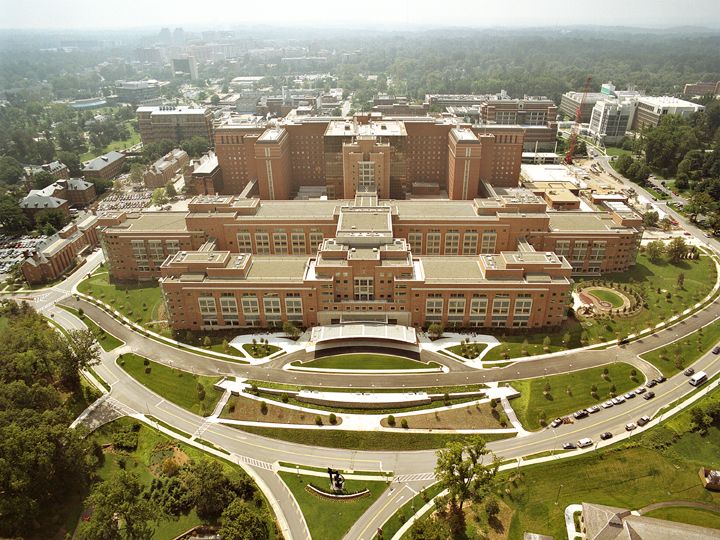
And so, here I am, in the heart of suburban Bethesda (stop with the excitement), down the street from the NCI. Esther and I flew across the country on super-short notice after getting the call and met with the team here at the NCI Clinical Center last week. The team is super engaged with us and the center as a whole is really impressive (our tax dollars at work), and their opinion is the reverse of what is commonly held for young patients (see above) — rather than start with “scorched earth” just because I’m young and my body can handle it, why not try a promising novel treatment that will [likely] come with fewer severe symptoms, leave me with less long-term damage, has a very high confidence of remission, and doesn’t close the door to future treatments in case it doesn’t give me remission beyond a few years?
Plus I get to contribute to SCIENCE!!!
I came to the conclusion pretty quick that this treatment just lines up way better with how I want to treat my body and how I have always thought about risk. So I’m quite excited, and quite hopeful. This week I am going through a battery of tests to validate that I’m still eligible for the trial and to get baselines. It’s gonna be... well, let’s just say I’d prefer to be sitting on a beach in Mexico:
- Monday: Another tumor biopsy
- Wednesday: A bone marrow biopsy and a lumbar puncture
- Thursday: More blood draws and meeting with the team to review results
- Friday: A PET scan to determine where else the lymphoma may be living and provide a “baseline” for later
If all goes well, I’d start treatment on Friday. The only thing that could conceivably knock me out of the trial is if lymphoma is detected in my spinal fluid — the trial is not approved for patients with that condition. That would also indicate a much more difficult-to-treat form of MCL. So far none of the study applicants have exhibited this condition, so keep your fingers crossed for me.
Either way, by Friday I’ll either start treatment here at the NCI (which will see me hanging out here through the weekend at least, then coming back every 3 weeks for a few days), or will head back to Seattle to begin one of the chemo treatments. It feels good to finally reach this point where I can lock down a plan — I feel grateful to get here so quickly (a little under a month from my diagnosis), but also it’s felt like an eternity (see how I brought it all around again? aw yeah).
Obviously it’s pretty scary too. No matter what, things are about to get difficult. None of these treatments will be easy on my body, and none of them are predictable — there’s no really telling what’s ahead. Nothing in life has really prepared me for this.
In general I am feeling pretty good. I am feeling confident in my medical teams, confident about getting through treatment, confident that I have a supportive community around me, and confident about getting a remission one way or another. Physically I’m still feeling good. The tumor is definitely becoming more uncomfortable and has made it painful to lie in one position for too long, but other than that I’m still moving around, still eating well, still able to move around in the world. Today I walked a long section of the Chesapeake & Ohio Canal footpath, a nice nostalgic recall of my childhood growing up around here.

So here we go. Thank you for being here along the way. Stay tuned for more as we walk this path.